Steerprotocol Smart Pools
UpdatedHow do Smart Pools turn data into changes to liquidity? Steer Protocol’s automated vaults apply strategy rules to manage concentrated-liquidity positions in automated market maker (AMM) pools.
- Rebalancing reference
- Market prices, net asset value (NAV), or custom data, depending on the selected strategy.
- Position structure
- One or multiple liquidity positions, with price ranges and placement determined by the strategy.
- Execution funding
- An associated gas vault holds the blockchain’s native currency to reimburse executing Steer nodes. Insufficient gas stops rebalancing.
How do placement rules and triggers differ?
Concentrated liquidity assigns capital to defined price intervals. Placement rules determine those intervals; rebalance triggers specify when a strategy should adjust its positions.
Classic Rebalance normally centers a new position on the current pool price, using a configurable width. It also supports other placement modes and configurable triggers. Static Super Wide maintains one broad position around a configured starting center. Its range stays fixed, and the price can still move outside it.
Price Gap uses a configured distance from the position center. Price Percentage Drift measures distance from that center relative to the active range’s size. Range Inactive responds when price leaves the active range. One-Way Range Exit responds only in the configured direction, above or below the range.
For documented trigger styles other than
None
,
elapsedTendTime
sets a time-based accounting-update condition in seconds. It prompts execution when that interval elapses, even without a price trigger. Selecting
None
removes automatic price-based triggering; other factors or manual intervention can govern rebalancing.
How does a strategy reach the blockchain?
A Steer app’s data pipeline can incorporate external inputs, onchain view-function results, and data retrieved through TheGraph. Nodes then execute its offchain logic as WebAssembly (WASM), processing supplied data to determine onchain actions.
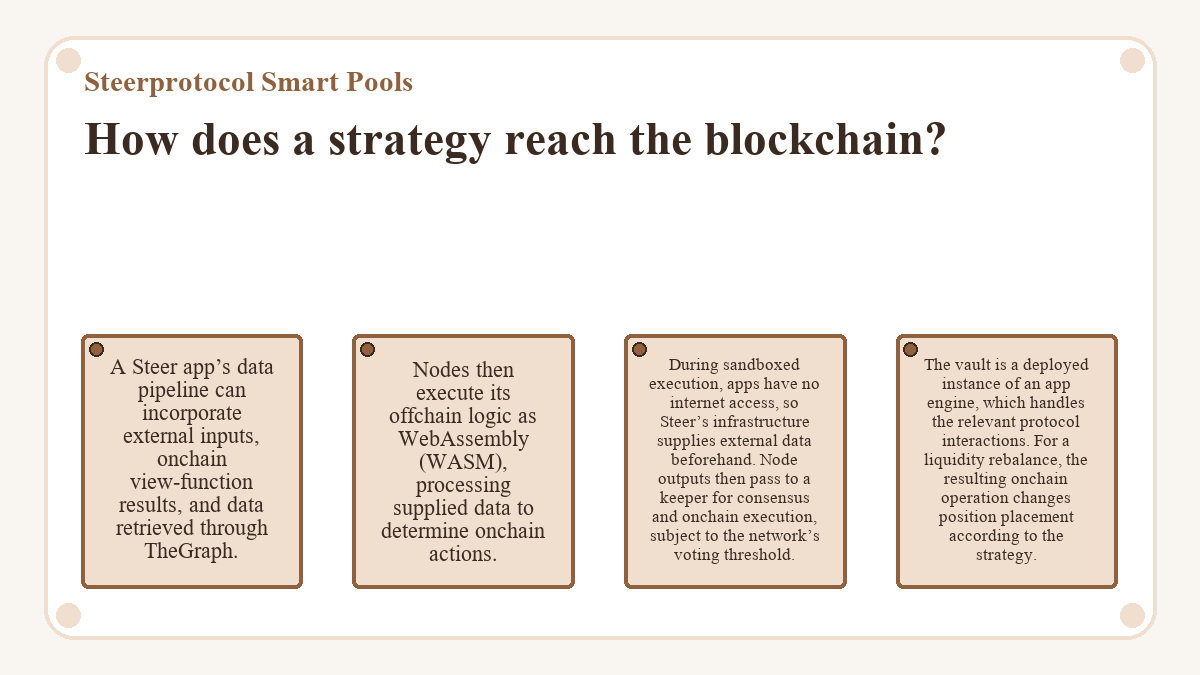
During sandboxed execution, apps have no internet access, so Steer’s infrastructure supplies external data beforehand. Node outputs then pass to a keeper for consensus and onchain execution, subject to the network’s voting threshold.
The vault is a deployed instance of an app engine, which handles the relevant protocol interactions. For a liquidity rebalance, the resulting onchain operation changes position placement according to the strategy.
When gas limits rebalancing
A Smart Pool needs enough gas to execute even when its strategy’s rebalance conditions are satisfied. Its remaining-execution estimate uses average gas consumption per rebalance. Actual consumption varies with position count and any swapping involved, so the estimate can differ from subsequent usage.
Strategy selection checklist
- If liquidity must follow changing prices, distinguish a rebalancing strategy from Static Super Wide’s fixed position.
- If adjustments depend on direction, match the One-Way Range Exit setting to the intended upward or downward move.
- If ongoing rebalancing matters, check the associated gas balance and account for variable execution costs.